Connecting Streaming Platforms
Connect YouTube, Twitch, Facebook, TikTok, LinkedIn, and other platforms to playout.video. Stream to one or multiple destinations simultaneously.
Introduction
Destinations are where your live stream is broadcast. playout.video supports 20+ streaming platforms, from YouTube and Twitch to TikTok, Facebook, and any service that accepts RTMP. You can stream to a single platform or broadcast to multiple destinations simultaneously (multistreaming).
This guide covers how to connect platforms, manage destinations, and choose which destinations start with your stream.
Supported Platforms
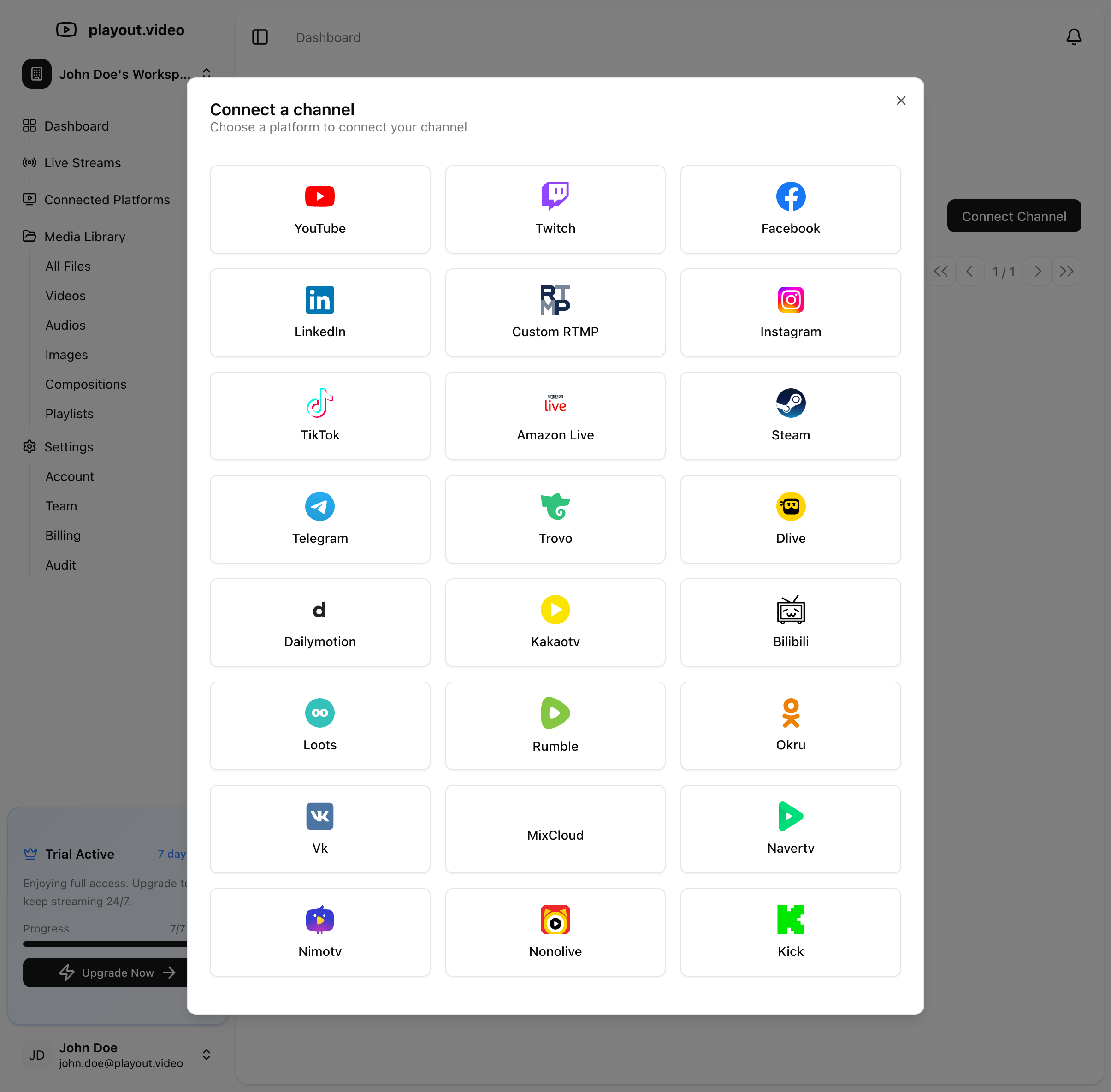
playout.video supports the following platforms with one-click OAuth connection:
YouTube: the most popular platform for 24/7 streams
Twitch: ideal for gaming and entertainment content
Facebook: stream to pages, groups, or your personal profile
LinkedIn: professional live streaming for businesses
Custom RTMP
For any platform not listed above, you can use Custom RTMP:
Rumble
TikTok
Instagram
Telegram
Steam
Amazon Live
Kick
DLive
Restream.io
Any service that provides an RTMP URL and stream key
Connecting a Platform via OAuth
OAuth-supported platforms (YouTube, Twitch, Facebook, LinkedIn) use a secure authorization flow, so you never need to share your password.
Step 1: Go to Channels
Go to Channels from the main sidebar navigation
Click Connect Channel
Select the platform you want to connect
Step 2: Authorize Access
You'll be redirected to the platform's login page
Sign in to your account (if not already signed in)
Grant playout.video permission to stream on your behalf
You'll be redirected back to playout.video
The connected channel will now appear in your Channels list with its name and profile picture.
Facebook and LinkedIn: Profile or Page
Facebook and LinkedIn show two buttons under Connect: Profile and Page. Both connect the same account. The difference is what the platform lets playout.video reach:
Profile asks for permission to stream to your personal profile only.
Page also asks for permission to see and stream to the Pages you manage.
Pick Page if you plan to stream to a Page. You choose the actual Page later, when you add the channel as a destination (the Facebook Target or LinkedIn Target dropdown). The channel card shows "Profile only" or "Profile + N Pages", so you can see which permissions the connection has.
Connected with Profile and now need a Page? Reconnect the same channel and pick Page. This upgrades the existing connection; no second channel is created.
LinkedIn also decides who may go live. A LinkedIn channel's page shows Live enabled or Live unavailable for your profile and each Page you administer. Live unavailable means LinkedIn has not given that profile or Page live access yet. When LinkedIn does, reconnect the channel so playout.video sees it.
Step 3: Add as a Destination
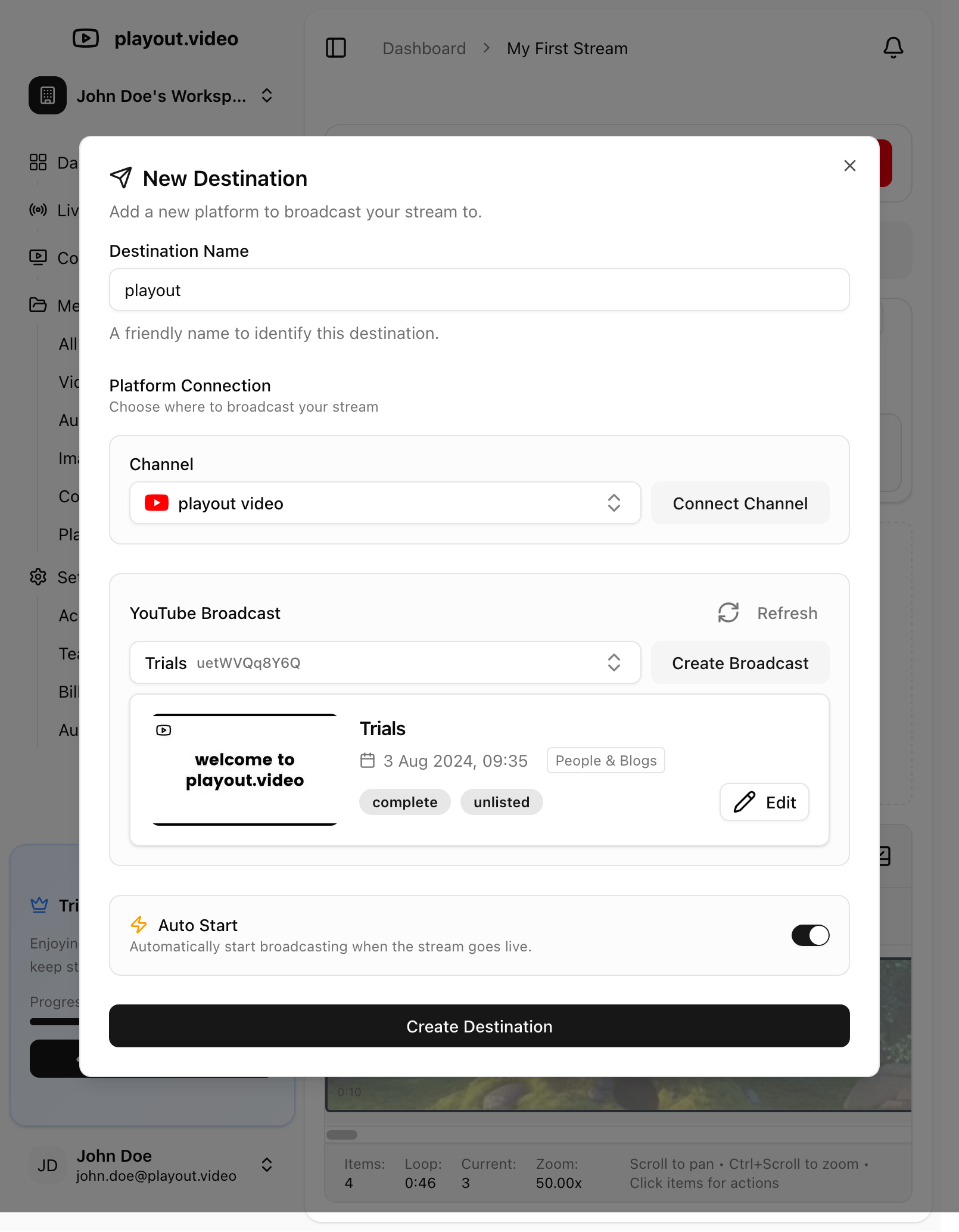
Once a channel is connected, you can add it as a destination to any live stream:
Open your live stream's management page
Click Destinations in the sidebar
Click Add Destination
Select your connected channel from the dropdown
Configure destination-specific settings (title, description, visibility)
Click Create Destination
Connecting via Custom RTMP
For platforms that don't support OAuth, use Custom RTMP:
Step 1: Get Your RTMP Credentials
From your streaming platform (e.g., Rumble, Kick, Telegram):
Go to your platform's live streaming settings
Find the RTMP Server URL (sometimes called "Stream URL" or "Ingest URL")
Copy the Stream Key
Step 2: Connect It as a Channel
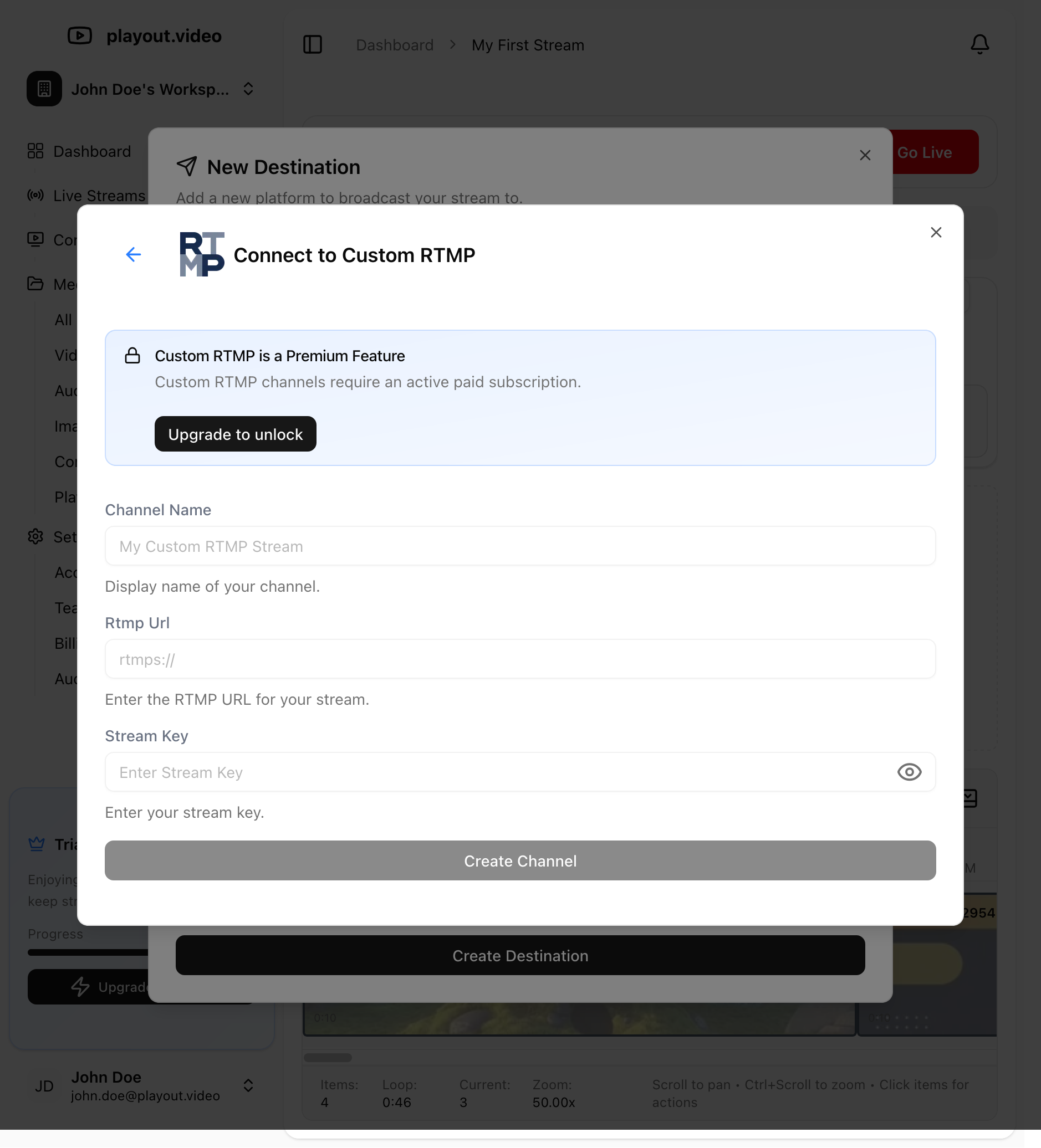
Go to Channels and click Connect channel
Pick the platform, for example Rumble, Kick or Telegram. For a service that is not listed, pick Custom RTMP
Give it a recognizable Channel Name (e.g., "My Rumble Channel")
Enter the RTMP URL (e.g.,
rtmp://live.example.com/live). For many platforms the field shows their usual server as a hintEnter the Stream Key
Click Create Channel
Then add it to your stream like any other channel: open the stream, go to Destinations, click Add Destination and pick the channel.
Destination Settings
Each destination has configurable options:
Start With the Playout
Start with the playout decides whether a destination sends video when your stream starts. It is on for every new destination.
On: the destination starts sending whenever the stream starts, whether you start it, the calendar starts it, or the AI assistant does.
Off: the destination stays idle until you start it from its menu in Destinations, each time the stream starts.
If every destination is off, the stream runs but reaches no platform.
To change it, open the destination's menu in Destinations and tick Start with the playout, or edit the destination. The change applies the next time the stream starts.
This is not YouTube's Publish when video arrives, which decides whether a YouTube live goes public on its own once video reaches YouTube. See YouTube Live Settings Explained.
Platform-Specific Settings
Depending on the platform, you may be able to configure:
Stream title: the title shown on the platform
Description: stream description for viewers
Visibility: public, unlisted, or private (YouTube)
Category: content category for discoverability
For what each YouTube setting does, including who can watch and what happens to the YouTube live when you stop the stream, see YouTube Live Settings Explained.
Multistreaming
Multistreaming means broadcasting to multiple platforms at the same time from a single stream. This maximizes your reach without any extra effort.
How to Set Up Multistreaming
Connect all the platforms you want to stream to (see steps above)
Add each platform as a destination on your live stream
Leave Start with the playout on for each destination
Start your stream, all destinations go live simultaneously
Example setup:
YouTube (Start with the playout: on)
Twitch (Start with the playout: on)
TikTok (Start with the playout: on)
Facebook Page (Start with the playout: on)
When you click "Go Live", your content broadcasts to all four platforms at once.
Managing Individual Destinations
You can start and stop individual destinations independently:
Start a destination while the stream is already running, useful for adding a platform mid-stream
Stop a destination without stopping the entire stream, useful for ending on one platform while continuing on others
Schedule destination start/stop, automate when specific platforms go live (see Scheduling Streams and Automated Actions)
Managing Connected Channels
Viewing Connected Channels
Go to Channels to see all your connected platforms:
Channel name and profile picture
Platform type (YouTube, Twitch, etc.)
Connection status (active, expired, error)
Reconnecting a Channel
If a channel's authorization expires:
Go to Channels
Find the channel with an expired status
Click Reconnect
Complete the OAuth flow again
Most platforms, YouTube and Twitch among them, renew their sign-in by themselves. Facebook and LinkedIn give one that runs out after a set time and cannot renew, so their channel page shows Expires in with the time left. Reconnect before then: once it runs out, the channel cannot go live until you reconnect it.
Removing a Channel
To disconnect a platform:
Go to Channels
Find the channel you want to remove
Click Remove or Disconnect
Removing a channel also removes it from any live stream destinations that use it.
Platform-Specific Tips
YouTube
YouTube is the most popular platform for 24/7 streams
Set Who can watch to Unlisted while testing, then switch to Public when ready. Only public lives count toward the watch hours the YouTube Partner Program asks for
YouTube may take a few minutes to start showing your stream to viewers after going live
Turn on DVR (rewind) with Edit in the YouTube panel, before the live starts, so viewers can rewind
YouTube may not save a live longer than 12 hours. For a 24/7 stream, see Keep Every YouTube Live on a 24/7 Stream
Twitch
Twitch streams are always public
Make sure your Twitch account is in good standing to avoid stream interruptions
Consider setting a category and tags in Twitch for discoverability
You can stream to your personal profile or to any Page you manage. Connect with Page to see your Pages when adding the destination
Facebook Pages are recommended for 24/7 streaming: they have better analytics, and Page broadcasts are public by default
Streaming to a personal profile: the destination has a "Who can see the live video" setting (Public by default). Facebook applies it when the broadcast starts and does not let you change the audience until the broadcast ends
Facebook may limit stream duration for personal profiles
TikTok
TikTok Live has specific requirements (minimum follower count may apply)
Vertical (9:16) aspect ratio works best for TikTok
Consider using playout.video's aspect ratio settings to optimize for TikTok
Troubleshooting
Destination shows "Error" or "Disconnected"?
The platform authorization may have expired, try reconnecting the channel
Check that your platform account is in good standing
For Custom RTMP, verify the URL and stream key are correct
Stream is live but not showing on the platform?
Some platforms take 30-60 seconds to start displaying the stream
Check the platform's live dashboard to confirm the stream is being received
For YouTube, make sure the stream visibility is set to Public or Unlisted
Can't connect a platform?
Make sure you're signed into the correct account on the platform
Clear your browser cookies for the platform and try again
Some platforms require your account to meet certain criteria (e.g., TikTok follower count)
Multistreaming quality issues?
playout.video handles all encoding in the cloud, so multistreaming doesn't affect quality
Each destination receives the same high-quality stream regardless of how many destinations are active
Next Steps
Multistreaming to Multiple Platforms at Once, advanced multistreaming guide
Custom RTMP Destinations, detailed RTMP setup
Scheduling Streams and Automated Actions, automate destination start/stop
How to Stream to YouTube, Twitch, and TikTok Simultaneously, step-by-step multistreaming tutorial